Sound becomes too loud for long exposure at about 85 decibels (dB): around 8 hours a day at 85 dB is the usual workplace limit, and every 3 dB louder halves the safe time. At 94 dB the safe time is about an hour, and at 100 dB about 15 minutes. SoundPrint in CEMP Life measures the noise around you for 10 seconds, estimates the level in dB and tells you a safe exposure time based on WHO and NIOSH guidance.
Decibel chart: safe listening times
| Level | Typical source | Safe daily exposure (approx.) |
|---|---|---|
| 60 dB | Normal conversation | No limit |
| 70 dB | Busy office, vacuum cleaner | No limit for most people |
| 85 dB | Heavy traffic, food blender | About 8 hours |
| 88 dB | Lawn mower, loud workshop | About 4 hours |
| 91 dB | Underground train, power drill | About 2 hours |
| 94 dB | Motorbike, loud headphones | About 1 hour |
| 100 dB | Nightclub, concert near speakers | About 15 minutes |
| 110 dB+ | Live music front row, sirens | A few minutes or less |
Why 85 dB, and why does 3 dB matter so much?
Decibels are logarithmic. Every 3 dB increase doubles the sound energy reaching your ears, so the safe time halves. That is why the jump from a noisy street (85 dB) to a loud gym class (94 dB) cuts safe exposure from a working day to about an hour. Occupational guidance from NIOSH uses 85 dB over 8 hours with this 3 dB rule; the WHO's safe listening guidance for personal audio is in the same spirit.
How loud is too loud for a baby?
Babies' ears are more sensitive than adults', and guidance for hospital nurseries keeps background noise at around 45 to 50 dB. For a white noise machine, that means:
- About 50 dB measured at the cot, roughly the level of a quiet conversation
- At least 2 metres (7 feet) from where your baby sleeps, and never inside the cot
- The lowest volume that works, on a timer
A 2014 study of 14 infant sleep machines found that every one could exceed 50 dB at maximum volume, so it is worth measuring the level at the cot. SoundPrint gives you a quick reading there.
How loud is too loud for headphones?
The WHO and ITU safe listening standard for headphones and earbuds sets a weekly allowance of 80 dB for 40 hours for adults, and 75 dB for 40 hours for children. Above that, the safe time halves with every 3 dB. In practice:
- Keep the volume at or below about 60 percent
- Take a break of a few minutes every hour
- Use noise-cancelling headphones so you are not turning the volume up to beat the train
- If someone next to you can hear your music, it is probably too loud
How to measure noise with your phone
- Open SoundPrint in the Health and Wellness pod.
- Hold the phone still in the place you want to measure.
- Tap Start. SI captures 10 seconds of ambient sound and converts the peak level to an approximate dB reading.
- Read the level, what it compares to, and the estimated safe exposure time.
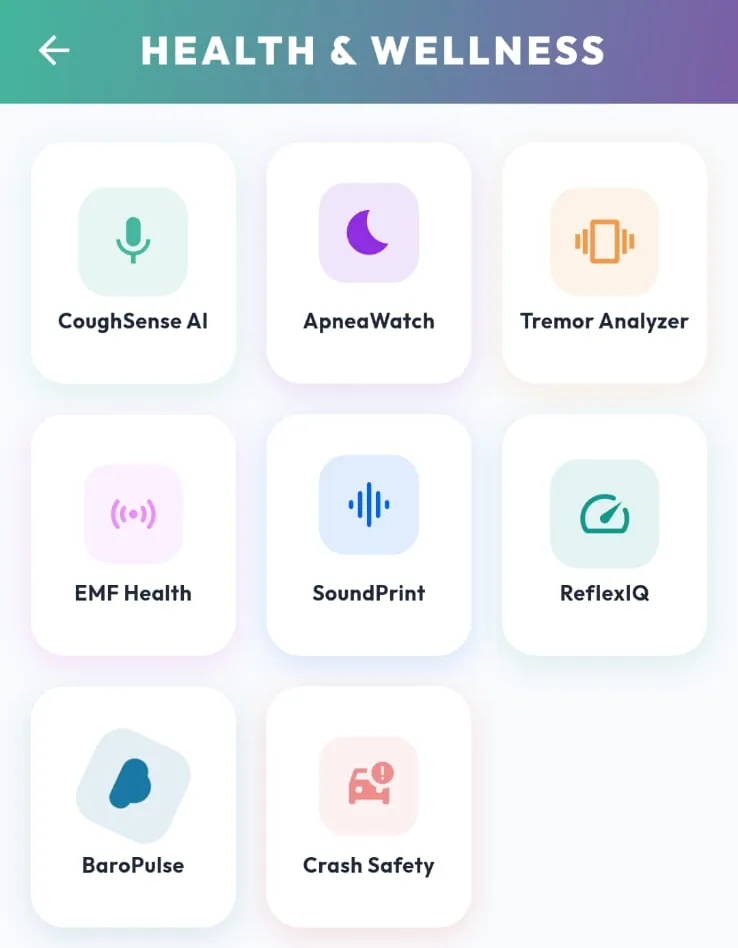
Measure where you spend hours: the open-plan office, the commute, the workshop, the gym, the bar where you work.
Measure the noise around you in 10 seconds.
CEMP Life puts 20+ SI tools in one app: calorie counter, food and allergen scanner, recipe maker, wellness sensors, crash detection, car diagnosis, contract checker, receipt scanner and a full creator studio. No account needed. Nothing stored.

4-day free trial on Google Play. Cancel any time.
Signs your hearing is under strain
- Ringing or buzzing in your ears (tinnitus) after a noisy place
- Sounds seem muffled for a while afterwards
- You need to raise your voice to be heard at arm's length
- Speech sounds unclear in background noise
Temporary dullness after a concert is a warning. Repeated often enough, it becomes permanent.
How to protect your hearing
- Step away from the source: doubling your distance cuts the level noticeably
- Take breaks in quiet places during long exposures
- Use earplugs at concerts and in loud workplaces
- Keep headphone volume at or below about 60 percent, and prefer noise-cancelling headphones so you do not turn the volume up to beat background noise
How accurate is a decibel meter app?
Phone microphones are designed for speech and can under-read very loud sound. Treat the result as a good approximation for comparing places and spotting risky environments. Legal or workplace compliance needs a certified sound level meter. For awareness, that is exactly what you need.
For other environment checks, see how to measure EMF with your phone and can weather changes cause headaches?, or the full health and wellness app overview.
Measure the noise around you in 10 seconds.
CEMP Life puts 20+ SI tools in one app: calorie counter, food and allergen scanner, recipe maker, wellness sensors, crash detection, car diagnosis, contract checker, receipt scanner and a full creator studio. No account needed. Nothing stored.
4-day free trial on Google Play. Cancel any time.