Most smartphones have an accelerometer, a gyroscope, a magnetometer (the compass), proximity and ambient light sensors, microphones, cameras and GPS, and many Android phones also have a barometer. Add the neural processing chip that runs vision and audio models on the device and a modern phone is the most capable Super Intelligence (SI) device most people own. With SI interpretation, the same sensors become a calorie counter, cough analyser, tremor meter, stud finder, sound meter and crash detector.
Why the phone wins
- A dedicated neural chip runs models offline at almost no battery cost
- Seven or more sensors record far more than steps and screen rotation
- SI is the missing interpretation layer that turns raw readings into answers
- It is always with you, which no lab instrument can claim
The silicon part
Modern phones ship with neural processing units built for the matrix maths that neural networks run on. They execute compact vision and audio models in real time while using very little power. A class of task that needed a server three years ago now runs locally, offline, at zero marginal cost.
BG Remover in CEMP Life is the clearest example: it isolates the subject and removes the background entirely on the phone, with no internet. On-device processing is faster (no network round trip), works without signal, and cannot leak, because nothing was sent. See how to remove the background from a photo.
The sensor part, which matters more
A modern phone contains an extraordinary measurement kit:
- A microphone that captures acoustic detail well beyond speech
- A three-axis accelerometer sensitive enough to register small vibrations
- A gyroscope for orientation and rotation
- A magnetometer that measures magnetic fields in microtesla
- A barometer that reads air pressure finely (on many models)
- Multiple cameras, often with depth information
- GPS and precise timing
For most of the smartphone era these fed step counters, screen rotation and maps. The data was rich; the interpretation was missing. Super Intelligence is the interpretation layer.
Super Intelligence in your pocket. Free to try.
CEMP Life puts 20+ SI tools in one app: calorie counter, food and allergen scanner, recipe maker, wellness sensors, crash detection, car diagnosis, contract checker, receipt scanner and a full creator studio. No account needed. Nothing stored.

4-day free trial on Google Play. Cancel any time.
What a phone plus SI can do
Each of these is a phone sensor plus an SI model, with no extra hardware:
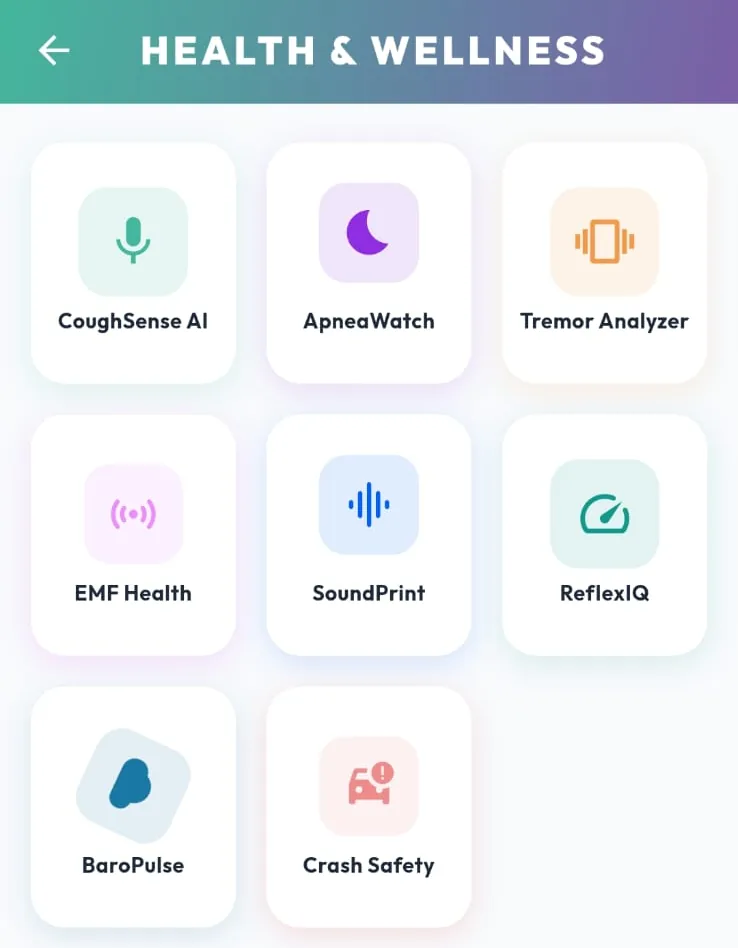
- Acoustic health signals: CoughSense classifies a cough; ApneaWatch hears snoring and breathing interruptions overnight. See sleep apnea at home.
- Vibration diagnostics: MechSense records 10 seconds of vibration and sound from a running machine to flag faults. See washing machine noise.
- Tremor measurement: Tremor Analyzer reads the dominant tremor frequency in hertz. See why are my hands shaking?
- Field and noise measurement: EMF Health reads magnetic fields; SoundPrint estimates decibels with safe exposure time. See how loud is too loud?
- Structural detection: Stud Finder detects ferrous metal behind plasterboard. See find a stud with your phone.
- Pressure trends: BaroPulse tracks pressure change linked to weather headaches. See can weather cause headaches?
- Impact detection: Crash Safety watches for freefall and impact, then alerts your emergency contact. See crash detection for Android.
A few years ago each would have meant buying a separate gadget: stud finder, sound meter, vibration analyser, EMF meter. The hardware was already in your pocket.
How do I check which sensors my phone has?
The full specification page for your model lists its sensors, usually under a heading such as Sensors or Features. On Android you can also install a sensor information app, which shows every sensor the system reports with live readings, so you can move the phone and watch the numbers change.
| Sensor | What it measures | Example use |
|---|---|---|
| Accelerometer | Movement and impact | Crash Safety, Tremor Analyzer |
| Gyroscope | Rotation and orientation | Navigation, games, screen rotation |
| Magnetometer | Magnetic field strength | Compass, EMF Health, Stud Finder |
| Proximity sensor | Something close to the screen | Turning the screen off during calls |
| Ambient light sensor | Brightness around you | Automatic screen brightness |
| Barometer | Air pressure | Altitude, BaroPulse |
| Microphone | Sound | CoughSense SI, ApneaWatch, SoundPrint |
| Camera | Images | CalorieScan, PureScan SI, Auto SI, ClauseGuard |
| GPS | Location | Maps, Crash Safety alerts |
A barometer is common on mid-range and flagship Android phones and missing on many budget models, so check for one before relying on a pressure tool.
Why most apps do not do this
- Sensor work is harder than API work. Wrapping a chatbot takes a weekend. Pulling reliable signal from raw accelerometer data takes signal processing and trained models.
- It does not fit the data business model. Local processing produces nothing to sell.
- It resists single-purpose apps. A sensor pipeline only pays off when many features share it, which favours a platform like the Core Engine Mesh Protocol.
Where this goes
Mobile neural chips are improving faster than most people track, and models are getting smaller and sharper. Tasks that need server inference today will move onto the phone, and the privacy and offline advantages will follow. Your phone is not a terminal for intelligence hosted elsewhere. It is a sensor-rich computer that is always with you.
Super Intelligence in your pocket. Free to try.
CEMP Life puts 20+ SI tools in one app: calorie counter, food and allergen scanner, recipe maker, wellness sensors, crash detection, car diagnosis, contract checker, receipt scanner and a full creator studio. No account needed. Nothing stored.
4-day free trial on Google Play. Cancel any time.